Why Thoughtful Designers Aren’t Afraid of AI
Using AI in a thoughtful way
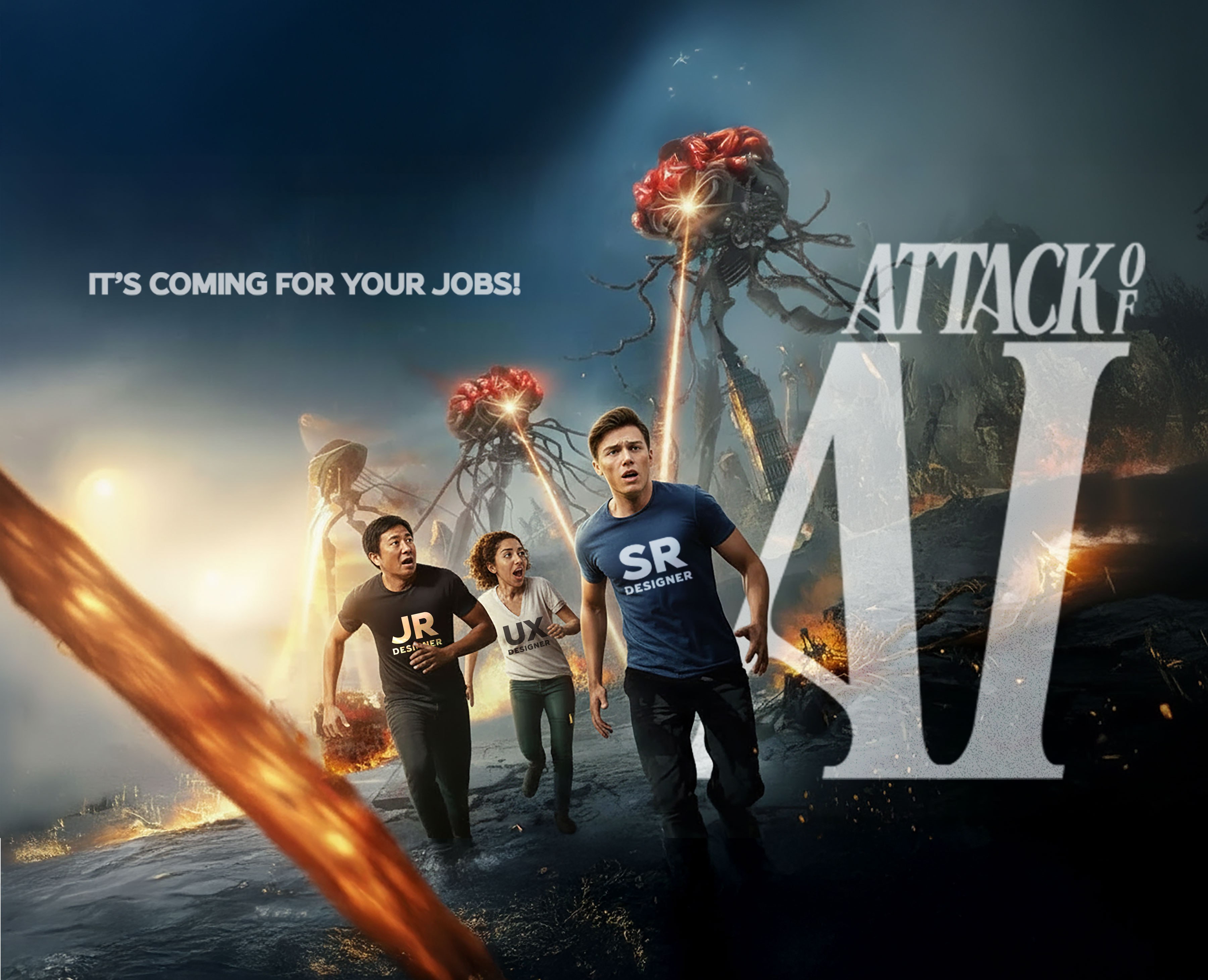
A few months ago I created the image at the top of this article: giant AI monsters towering over a group of designers while a warning screams, "It's Coming For Your Jobs!"
The image was intentionally dramatic because that's often how AI conversations feel right now. Scroll through LinkedIn for five minutes and you'll likely find someone declaring RIP designers, RIP developers, RIP writers, or RIP whatever profession they're worried about that week.
Over the last year I've spent a lot of time exploring AI, not in a hype-driven way, but in a practical one. How does it fit into real workflows? What does it actually save time on? Where does it still require human judgment, editing, and decision-making?
Along the way I've had conversations with designers, creative directors, product leaders, and hiring managers. Some questioned why I wasn't using more AI. Others wondered if I was using too much. Some asked whether it felt unethical. Others questioned whether the work was still mine.
At the same time, most of the industry discussion seemed to fall into two camps: AI is replacing everyone, or AI is solving everything.
After a year of experimenting with it myself, I don't believe either is true.
What I do believe is that AI is one of the most significant shifts our industry has experienced in years.
So I stepped back and asked a simpler question. What does this moment actually feel like?
We have been here before
This is not the first time our industry has gone through a shift like this.
When desktop publishing became mainstream, many believed computers would replace traditional design skills. The reaction was predictable. Computers were accused of doing the work for designers, "real design" was supposedly hand-done, and for a while the industry produced a lot of questionable work simply because the tools made it possible. Typography probably suffered the most, with stretched and distorted type appearing everywhere.
Eventually, the noise settled and designers remembered an important truth: tools do not replace understanding. A computer does not make someone a designer any more than a paintbrush makes someone a painter. Skill, taste, judgment, and restraint still mattered.
We saw a version of this again with Sketch, InVision, and later Figma. For a while, some believed design systems and collaborative tools would dramatically compress timelines and remove complexity from the process. They improved productivity, but they didn't remove the need for alignment, critical thinking, or decision-making.
AI feels like a bigger shift than any of those, but the pattern is familiar. New tools change how we work, yet the value still comes from the people using them, not the software itself.
AI is a tool, not a replacement
Over the last few months, I've used AI regularly for concept exploration, creative direction, image generation, documentation, content organization, and challenging my own thinking. It has become another tool in my process, much like Photoshop, Figma, or any other software I use throughout the day.
What surprised me wasn't what it could generate. It was how much potential it had to help people discover things.
The more I experimented, the less interested I became in AI creating content and the more interested I became in AI helping people navigate it. For years we've relied on search, metadata, categories, and carefully structured information architecture to help people find information. AI introduces another layer, one that allows people to explore content through intent and context rather than simply knowing where to look.
That shift has influenced how I think about my own work, from building an AI-assisted design system with searchable documentation and reusable patterns to exploring ways AI can connect information across workflows and make knowledge easier to access.
After months of experimenting, my view is fairly simple: AI is incredibly useful, but it's not a replacement for expertise. It gets a lot right, but it also gets a lot wrong. The value isn't in accepting the output, it's in knowing how to evaluate it, challenge it, refine it, and decide what is actually worth keeping.
We still need designers, arguably more than ever
One concern I have with the current conversation is the assumption that learning can be skipped.
If junior designers are replaced before they have a chance to develop judgment, where does the next generation of experienced designers come from? Design isn't learned through prompts alone. It develops through repetition, critique, experimentation, failure, and experience.
AI can accelerate learning, but it can't replace the process of becoming good at something.
The future still needs thoughtful designers. The challenge is ensuring we continue creating opportunities for them to learn while embracing the tools that can help them work more effectively.
Key Takeaway The biggest shift in my thinking wasn't around what AI could create, but how it could help people discover information. While I still use it for concept exploration, image generation, documentation, and workflow acceleration, I've become increasingly interested in its ability to connect knowledge and make complex systems easier to navigate. The most valuable applications I've found aren't about generating more content, but helping people get more value from the information that already exists.
date published
12 Dec 2025
reading time
5 min read